
In the day‑to‑day operations of organizations, it is common to record situations that need to be analyzed: an error that occurred, a suggestion for improvement, a customer‑reported issue, or even an audit finding.
In Qualiex, these situations are recorded as occurrences, and to organize everything in a practical way, there are two main classifications: Occurrence Type and Occurrence Category.
What Is an Occurrence Type?
The Occurrence Type is the broadest level of classification. It indicates, in general terms, what the occurrence represents.
Some common examples include:
- Nonconformity → something did not go as expected, violating a rule, requirement, standard, or established procedure.
- Opportunity for Improvement → no error occurred, but there is a chance to enhance a process or outcome.
- Incident → an event that caused or could have caused a negative impact.
We can say that the Occurrence Type answers the question:
“What is this occurrence, in the most general sense?”
What Is an Occurrence Category?
The Occurrence Category is a more specific classification that describes the source or context of the record.
Some examples include:
- Customer Complaint
- Audit Finding
- Equipment Failure
- Process Error
This classification helps guide the handling and investigation of the occurrence, since each category may have its own steps, deadlines, and assigned responsibilities.
The category answers the question:
“Where did this occurrence come from, or in what context did it take place?”
The Difference Between Type and Category
To make the distinction clearer:
| Occurrence Type | Occurrence Category |
|---|---|
| Broad, high‑level view | Specific, detailed classification |
| Example: Nonconformity | Example: Customer Complaint |
| Indicates whether it is an error, suggestion, incident, etc. | Shows the source or reason for the record |
| Used for general statistics and performance indicators | Defines the treatment workflow and deadlines |
Another example:
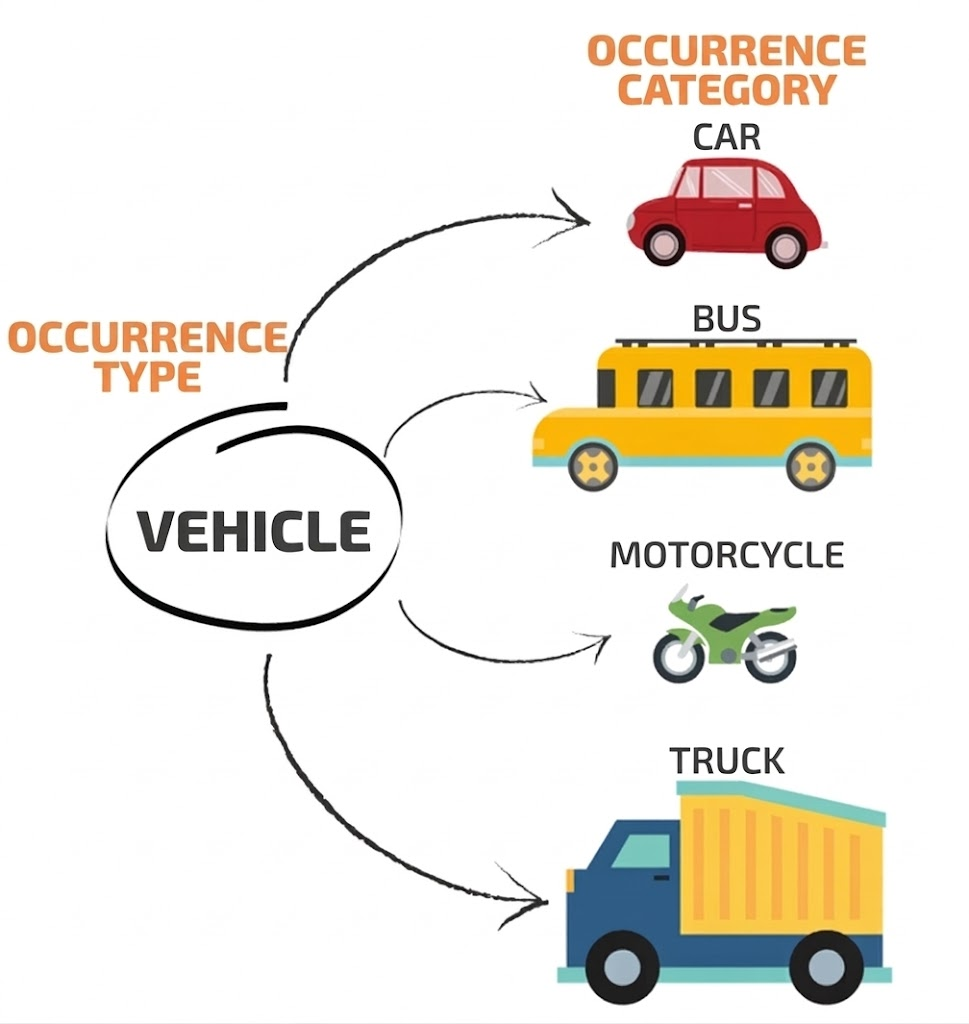
We can consider “VEHICLES” as a type.
Under this type, there are several categories, such as motorcycle, truck, car, bus, etc.
Why Is This Important?
Correctly classifying occurrences ensures:
- Organization: everything is recorded clearly and can be easily located.
- Agility: each occurrence follows the appropriate workflow without delays.
- Smart analysis: reports highlight where problems or opportunities exist, helping the organization drive continuous improvement.
In Qualiex, the Occurrence Type and Occurrence Category work together to ensure each record is properly understood, processed, and resolved in the best possible way.
The type provides the overall perspective, while the category offers the specific detail that guides the corrective or improvement action.