---
title: How to View the Compact Report of an Occurrence in Qualiex?
description: How to View the Compact Report of an Occurrence in Qualiex?
---
[Skip to content](https://qualiex.forlogic.net/en/how-to-view-the-compact-report-of-an-occurrence-in-qualiex#main-content)

Open main navigation
Close main navigation
How can we help you?
- There are no suggestions because the search field is empty.
1. [Qualiex | Knowledge Base](https://qualiex.forlogic.net/en?hsLang=en)
2. [Occurences](https://qualiex.forlogic.net/en/occurences?hsLang=en)
3. [General information](https://qualiex.forlogic.net/en/occurences?hsLang=en#general-information)
# How to View the Compact Report of an Occurrence in Qualiex?
### **What is the Compact Occurrence Report?**
The **Compact Report** is a consolidated view containing all relevant information about an occurrence, displayed by treatment step. It includes data such as:
- occurrence issuance
- treatment
- cause analysis
- action plan(s)
- total occurrence cost
- effectiveness verification
- final standardization, among others
### **Benefits of Using the Compact Report**
**Complete and structured view:**
Brings together all treatment steps in a single document, making it easier to understand the entire lifecycle of the occurrence.
**Tracking and traceability:**
Allows full monitoring of the occurrence’s history—from creation to standardization—making it ideal for audits and reviews.
**Quick access:**
The report can be opened directly from the occurrence, without needing to generate several separate documents.
**Transparency and sharing:**
By consolidating essential information, it facilitates communication among responsible parties and managers.
**Support for effectiveness analysis:**
With data such as effectiveness verification and costs, it becomes easier to evaluate the results of the implemented actions.
### 1. Access the Module
Click here to learn how to access the **Occurrences** module in Qualiex.
### 2. Locating the Compact Report
Click the **“Occurrences”** tab, locate the occurrence for which you want to generate the report, then right‑click it or open the context  menu and select **“View.”**
**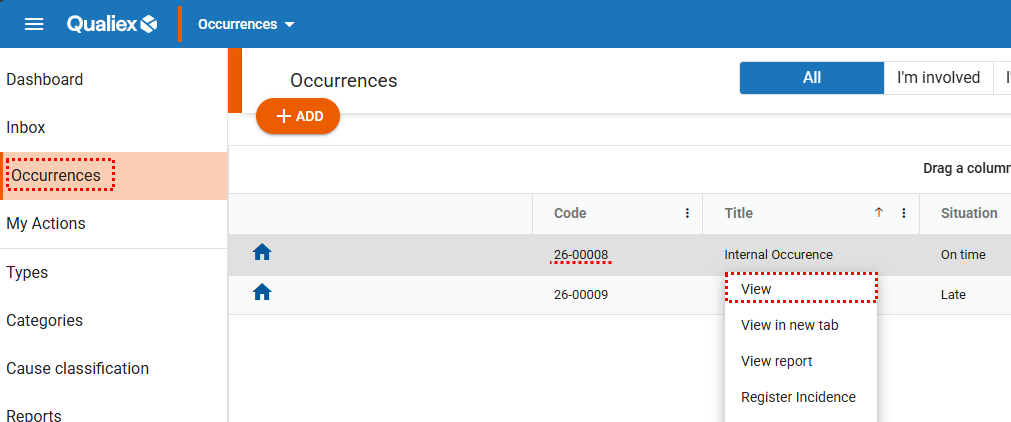**
When you click **“View”**, you will have access to the information of the current step of the selected occurrence.
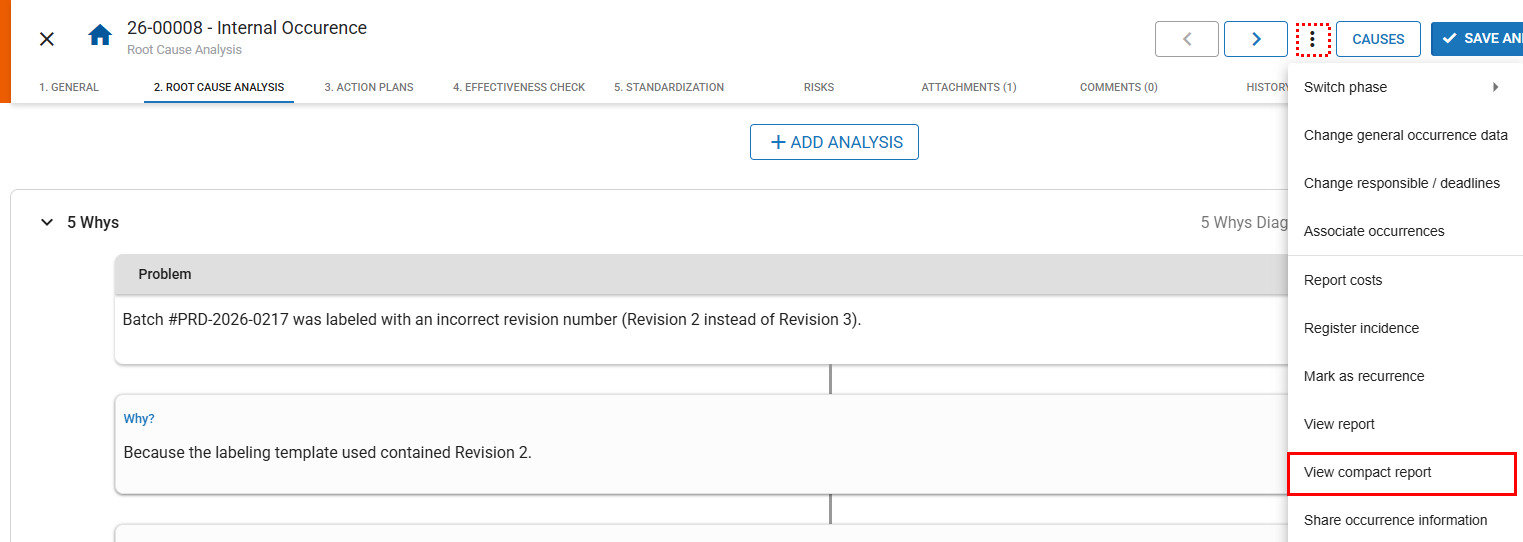
To generate the compact report, click the **context menu**  and select **“View Compact Report.”**
****
### **3. Opening the Report**
The report will be generated and will display the following information:
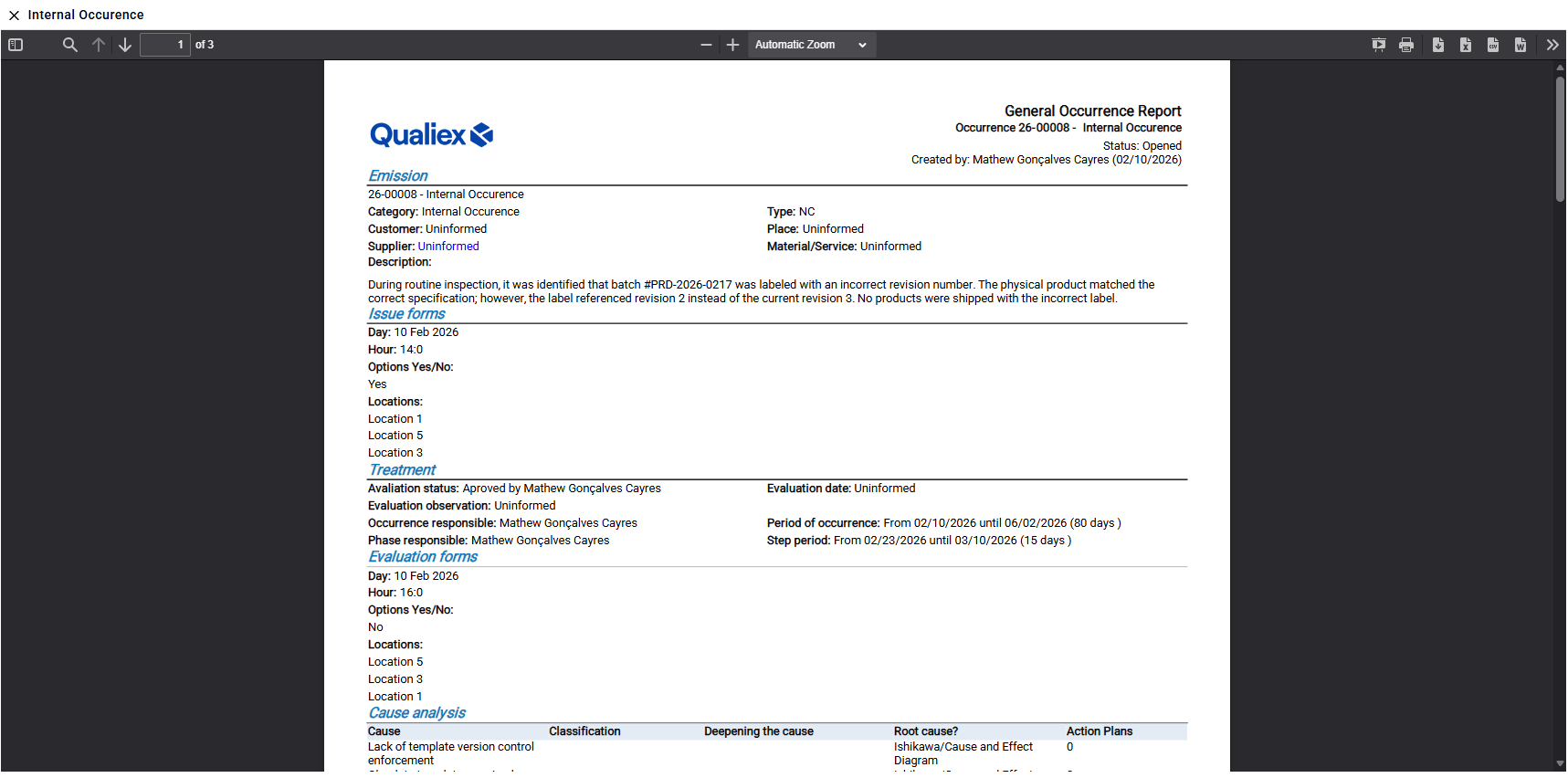
**Emission:** Registration information of the occurrence.
**Issue Forms:** Displays the fields from the form (custom fields), if any were linked to the registration step.
**Treatment:** Information from the occurrence’s evaluation step, performed by the approver.
**Associations:** Shows the linkage to other occurrences, if applicable.
**Cause Analysis:** Information entered during the cause analysis step, and it also shows the linkage to an action plan, if applicable.
- **Description of the cause:** Field completed during the cause analysis.
- **Action Plans:** All actions registered to address the root cause.
- **Total Cost of Occurrence:** A consolidated view of the information recorded in progress and cost reporting for the actions related to the occurrence.
- **Effectiveness Check:** Information completed in the effectiveness verification step.
- **Standardization:** Information completed in the standardization/communication step.
- **Attachments:** Displays the names of the files attached to the occurrence and actions; images will be shown directly in the report.
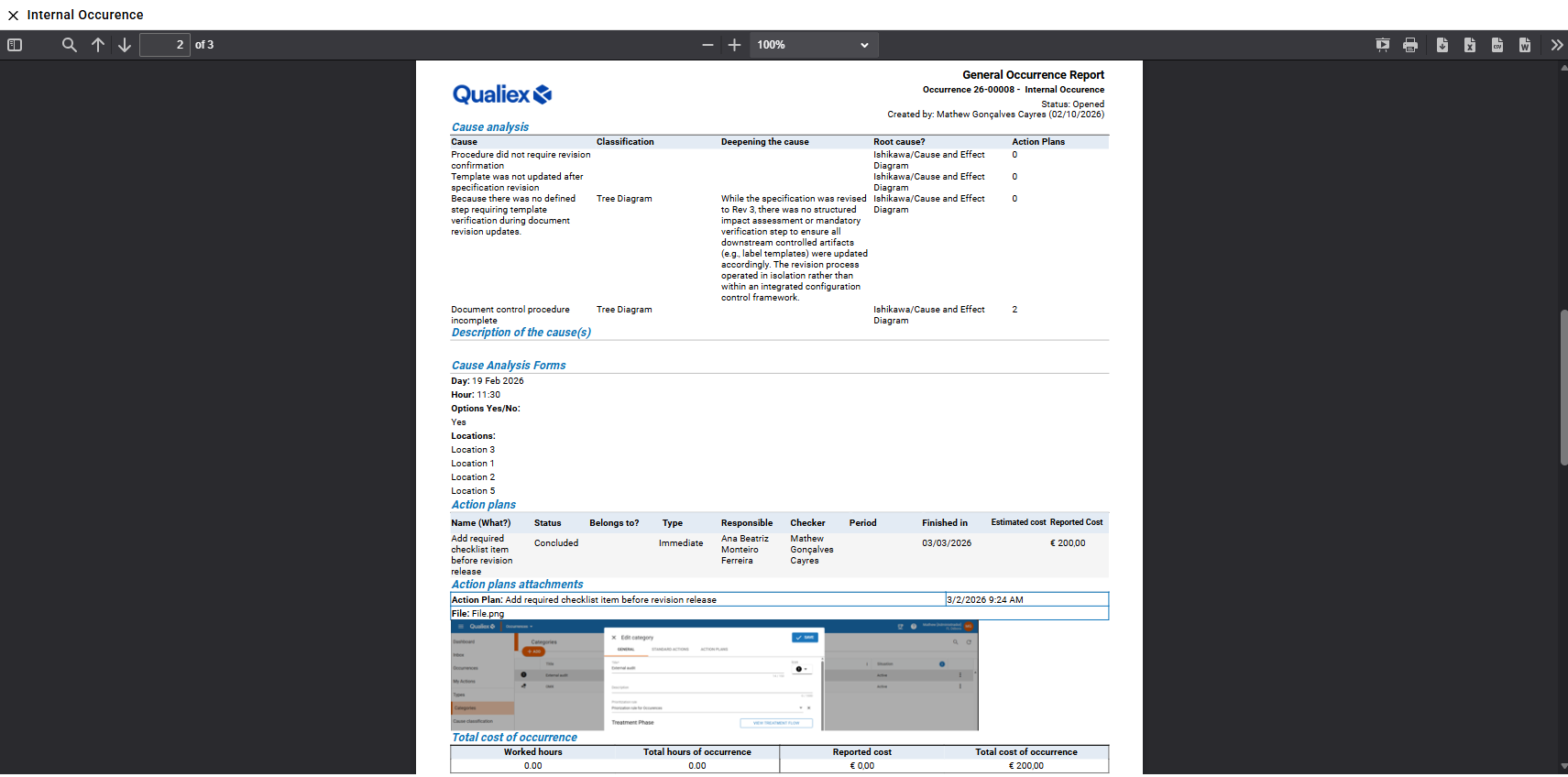
The report will be formatted according to the specific steps of each occurrence.
### 4. Report Options
In the options bar (top section), you can:
- **Navigate between pages** without leaving the current screen — simply click the **page navigation button**  and choose the desired page.
- **Search for a word or phrase** within the report — by clicking the **search button**, you can type and navigate between search results.
- **Move to the next or previous page**, or jump directly to a specific page number using the available navigation controls.
- **Decrease or increase the report zoom** using the **zoom controls**.
- **Use presentation mode** via the presentation button  , or **print** the report using the print button  .
- **Export the report** in several formats:
- PDF
- XLSX
- CSV
- DOCX
- For **additional options**, such as exporting with or without formatting, changing the report orientation, among others, click the **options button**.
At the bottom of each report page, you will find information for traceability: total number of pages, your company name, the date and time the report was viewed, and the site where it was accessed.
In the lower‑right corner, the **Forlogic logo** will appear.
These details confirm that the report was generated by a computerized system.

- [Occurences](https://qualiex.forlogic.net/en/occurences?hsLang=en#main-content)
- [Treating an occurence guide](https://qualiex.forlogic.net/en/occurences?hsLang=en#treating-an-occurence-guide)
- [Register Occurence](https://qualiex.forlogic.net/en/occurences?hsLang=en#register-occurence)
- [Inbox](https://qualiex.forlogic.net/en/occurences?hsLang=en#inbox)
- [Cause analysis](https://qualiex.forlogic.net/en/occurences?hsLang=en#cause-analysis)
- [Action plan elaboration and execution](https://qualiex.forlogic.net/en/occurences?hsLang=en#action-plan-elaboration-and-execution)
- [Effectiveness check](https://qualiex.forlogic.net/en/occurences?hsLang=en#effectiveness-check)
- [Standardization and disclosure](https://qualiex.forlogic.net/en/occurences?hsLang=en#standardization-and-disclosure)
- [Overview](https://qualiex.forlogic.net/en/occurences?hsLang=en#overview)
- [General information](https://qualiex.forlogic.net/en/occurences?hsLang=en#general-information)
- [My Actions](https://qualiex.forlogic.net/en/occurences?hsLang=en#my-actions)
- [Cause classification](https://qualiex.forlogic.net/en/occurences?hsLang=en#cause-classification)
- [Occurences Categories](https://qualiex.forlogic.net/en/occurences?hsLang=en#occurences-categories)
- [Types of occurrences](https://qualiex.forlogic.net/en/occurences?hsLang=en#types-of-occurrences)
- [Module Configurations](https://qualiex.forlogic.net/en/occurences?hsLang=en#module-configurations)
- [Reports](https://qualiex.forlogic.net/en/occurences?hsLang=en#reports)
[](https://qualiex.com/)
[mailto:contato@forlogic.net](mailto:contato@forlogic.net)
Copyright © 2026